
MIG vs TIG vs Arc Welding: Which Method & Equipment Do You Need?
If you’re setting up a new workshop or expanding your welding capabilities, you’re facing a fundamental question: MIG, TIG, or Arc? Each method has distinct strengths, different equipment requirements, and wildly different learning curves. This isn’t about theory, it’s about choosing the right welding process for your actual work and budget.
This MIG vs TIG vs Arc Welding guide breaks down the practical differences between the three so you can make an informed decision on which equipment to invest in. If you want the types of welding explained in a clear, practical way, this guide will help you weigh up what each method excels at, the kit you’ll need, and the honest trade-offs between speed, quality, and cost.
Browse our complete welding machinery and equipment range to see what’s available once you’ve decided which method suits your needs.
Quick Comparison: MIG, TIG & Arc Welding at a Glance
Before we get into the details, here’s how the three main welding methods stack up:
| Factor | MIG Welding | TIG Welding | Arc Welding |
| Best For | Steel, stainless, aluminium (thin to medium) | All metals, precision work, thin materials | Steel, cast iron (thick sections) |
| Skill Level | Beginner-friendly | Advanced | Moderate |
| Speed | Fast | Slow | Moderate |
| Weld Quality | Good | Excellent | Good |
| Portability | Moderate (needs gas) | Low (needs gas + more accessories) | High (self-contained) |
| Typical Cost | £200-£2,500 | £300-£3,500 | £150-£1,800 |
| Outdoor Use | Limited (gas protection) | No (wind disrupts shielding) | Yes (self-shielding) |
If you already know which method you need, jump straight to our specialist ranges:
What is MIG Welding? (Metal Inert Gas)

How MIG Welding Works
MIG welding, also called GMAW (Gas Metal Arc Welding), uses a continuous solid wire electrode fed through a torch while shielding gas protects the weld pool. The wire acts as both the electrode and the filler, melting into the joint as you move along the weld.
Shielding gas is usually pure CO2 for mild steel or an Argon/CO2 mix for stainless and aluminium. Because the wire feeds automatically, MIG is classed as semi-automatic: you control gun angle and travel speed, not the filler feed.
This continuous feed is why MIG has the highest deposition rate of the three methods, making it the preferred choice for repetitive production work where speed matters more than appearance.
What Materials Can You MIG Weld?
MIG handles most common workshop materials:
- Mild steel: the easiest material for MIG, from thin body panels (0.8mm) up to structural steel (12mm+)
- Stainless steel: requires tri-mix gas (Argon/CO2/Helium) for best results
- Aluminium: needs pure Argon gas and a spool gun or push-pull torch due to soft wire
- Not suitable for: Cast iron, very thin materials under 0.6mm
If you’re primarily working with automotive panels, gates, railings, or general fabrication in mild steel, MIG is your workhorse method.
MIG Welding Equipment You’ll Need
Here’s the full kit list for getting started with MIG:
Core Equipment:
- MIG welder unit – 140-200 amp range covers most workshop tasks
- Gas cylinder + regulator – CO2 or Argon mix depending on materials
- Wire spools – 0.6mm, 0.8mm, or 1.0mm diameter depending on material thickness
- Contact tips & nozzles – consumables that need periodic replacement
- Earth clamp – proper grounding is critical for clean welds
Safety Equipment:
- Auto-darkening welding helmet – essential for seeing the puddle clearly
- Welding gloves (MIG-specific with reinforced palms)
- Leather welding jacket
- Steel toe-cap boots
Shop our full range of MIG welding machines and welding wire and consumables to get set up properly.
What is TIG Welding? (Tungsten Inert Gas)

How TIG Welding Works
TIG welding, also known as GTAW (gas tungsten arc welding or tungsten inert gas welding), uses a non-consumable tungsten electrode to create the arc. You hold the TIG torch in one hand and manually feed the filler rod with the other, often using a foot pedal to control amperage and heat input.
Pure Argon shields the weld pool, and because the tungsten doesn’t melt into the joint, TIG welding produces very clean, precise welds with minimal spatter. The trade-off is that it’s a slower process than the MIG welding process and demands good coordination to manage torch position, filler addition, and pedal control together.
What Materials Can You TIG Weld?
TIG is the most versatile welding method in terms of material compatibility:
- Mild steel: perfectly fine, though slower than MIG
- Stainless steel: where TIG really shines with clean, corrosion-resistant welds
- Aluminium: requires AC capability (most modern TIG machines have this)
- Copper, brass, titanium, exotic alloys: TIG handles them all
- Extremely thin materials: down to 0.5mm sheet metal
If you work with thin-gauge materials, need impeccable weld appearance, or regularly tackle stainless and aluminium, TIG becomes worth the learning curve investment.
TIG Welding Equipment You’ll Need
TIG has a longer equipment list than MIG or Arc:
Core Equipment:
- TIG welder with AC/DC capability – AC for aluminium, DC for everything else
- Pure Argon gas cylinder – not the cheaper Argon/CO2 mix used for MIG
- Tungsten electrodes – different types for different materials (2% ceriated for mild steel/stainless, pure tungsten or zirconiated for aluminium)
- Filler rods – sold by material type and diameter
- Foot pedal – for amperage control (some machines use hand controls instead)
- Gas lens kit – improves gas coverage for cleaner welds
- Collet bodies, cups, and back caps – consumables specific to your torch size
Additional Accessories:
- Tungsten grinder – proper electrode preparation makes a huge difference to arc stability, and using dedicated grinding helmets and masks helps protect you from dust and sparks during setup.
- TIG torch – comes with the machine, but upgrades available
Check out our TIG welding machines range and TIG welding accessories for everything you need.
What is Arc Welding? (MMA/Stick Welding)
How Arc Welding Works
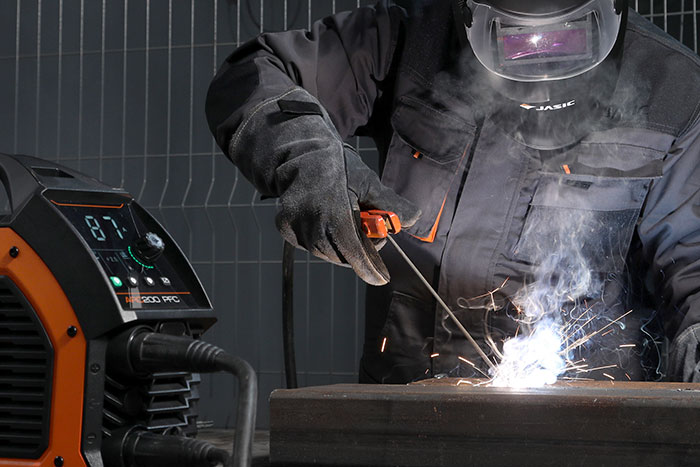
Arc welding, also known as MMA or stick welding, uses a flux-coated electrode; as it melts, the flux creates its own shielding gas so no external gas supply is needed.
This self-shielding makes Arc welding extremely portable and forgiving. It works well outdoors in wind, on rusty or painted steel, and in awkward welding positions where gas-shielded processes struggle. That’s why it’s a staple for site work, farm repairs, and maintenance jobs where you bring the welding machine to the job, not the other way round. The trade-off is more spatter, slag to chip off after each pass, and poor performance on thin material, as arc really shines on thick structural steel.
What Materials Can You Arc Weld?
Arc is more limited than MIG or TIG in terms of material range:
- Mild steel: Arc’s bread and butter, especially thick sections (3mm+)
- Stainless steel: possible with stainless electrodes, but TIG gives better results
- Cast iron: yes, with specialist nickel-iron rods
- Not suitable for: Aluminium, thin materials under 2.5mm
If you’re doing structural work, agricultural repairs, site fabrication, or any outdoor welding, Arc is often the most practical choice despite its limitations.
Arc Welding Equipment You’ll Need
Arc has the simplest equipment requirements:
Core Equipment:
- Arc/MMA welder – 140-160 amp handles most site work
- Welding electrodes (rods) – different types for different jobs (6013 general purpose, 7018 low hydrogen for structural work)
- Electrode holder – comes with the machine
- Earth clamp – standard welding clamp
- Chipping hammer & wire brush – for removing slag
Safety Equipment:
- Welding helmet – same as MIG/TIG
- Welding gloves – heavy-duty leather
- Protective clothing – Arc produces more spatter than MIG
Browse our MMA/Arc welding machines and welding rods range.
MIG vs TIG vs Arc: Which Method for Which Job?

Use this quick guide to match MIG, TIG and Arc welding to the jobs you actually do day-to-day.
Use MIG Welding For:
- Production & fabrication: Fast deposition for gates, frames, chassis and repeat work where speed matters.
- Automotive body panels: Thin steel (0.8–1.2mm) with good penetration and low risk of burn-through.
- General workshop use: Best “one machine” choice, comfortably handling most everyday jobs.
- Medium-thickness steel: Around 2–12mm with minimal setup; thicker sections possible with multiple passes.
Use TIG Welding For:
- Precision & visible welds: Architectural metalwork, artistic fabrication, prototypes and any work where appearance counts.
- Stainless steel: Clean, corrosion-resistant welds for food, brewing and hygienic environments.
- Thin materials: Around 0.5–3mm where tight heat control prevents distortion and burn-through.
- Aluminium & specialist work: Especially thin aluminium and high-spec jobs in motorsport, aerospace and marine.
- Critical welds: When quality and defect-free joints are mandatory.
Use Arc Welding For:
- Site & outdoor work: Construction, farms and maintenance where wind, rust and dirt rule out gas-shielded processes.
- Thick structural steel: Heavy fabrication (6mm+) with deep penetration and robust weld beads.
- Repairs & maintenance: Quick, simple setup for emergency fixes and awkward positions.
- Rusty or painted surfaces: More forgiving of less-than-perfect prep than MIG or TIG.
- Tight budgets: Low machine and running costs while still delivering professional results.
Running Costs: Consumables, Gas & Power

Running costs vary noticeably between the three welding processes. For MIG welders, most spend goes on external shielding gas and consumable wire electrode. A typical 200A machine on a 230V supply draws moderate power, while gas refills (CO2 or Argon mix) and wire spools add up over regular use. Contact tips and nozzles also wear through with spatter and heat. If you weld often, it pays to stock up on MIG consumables so you’re not stopping mid-job.
TIG welding is more expensive to run. The process relies on pure Argon gas flow, a non-consumable tungsten electrode in the TIG torch, and separate filler metal rods. While TIG welding machines usually draw slightly less power than equivalent MIG units, the gas, electrodes, cups and gas lenses push up overall cost, especially for stainless and aluminium TIG welds. For regular TIG work, it’s worth buying quality parts from a dedicated TIG accessories range.
Arc welding, or shielded metal arc welding, is the cheapest in terms of consumables. The coated, consumable electrode doubles as both filler material and shielding, so there’s no gas cylinder rental or refills to worry about. Apart from basic tools like chipping hammers and brushes, your only ongoing spend is on rods, though power draw is higher when you weld thick materials at higher amps. For the best value and performance, choose welding electrodes by type matched to your welding applications.
Equipment Costs: What to Expect
| Welding Process | Entry-Level | Mid-Range | Professional |
| MIG welders | 140-160A (hobby) – £200 – £500 | 180-220A (light trade) – £500 – £1,200 | 250A+ (industrial) – £1,200 – £2,500+ |
| TIG welding machines | 150-180A DC-only – £300 – £700 | 200-220A AC/DC – £700 – £1,500 | 250A+ AC/DC pulse – £1,500 – £3,500 |
| MMA / Arc welders | 140-160A (site work) – £150 – £400 | 180-200A (trade use) – £400 – £900 | 250A+ (industrial/structural) – £900 – £1,800+ |
Prices vary with duty cycle, amperage range, build quality (inverter vs transformer) and brand reputation, as higher-end machines give longer duty cycles, more stable arcs and better long-term reliability.
Ready to Choose Your Welding Equipment?
We stock a wide range of professional welding equipment, from entry-level machines for new workshops through to industrial-duty systems for production environments.
Shop by method:
- MIG Welding Machines – from £200
- TIG Welding Machines – from £300
- MMA/Arc Welding Machines – from £150
Complete your setup:
- Welding Consumables & Supplies – wire, rods, gas equipment
- Gas Equipment & Regulators – cylinders, hoses, flashback arrestors
- Welding Tables & Fixtures – professional work positioning
- Safety Equipment – helmets, gloves, protective clothing
Not sure which setup is right for you? Contact us for advice on choosing welding machines, consumables and safety equipment for your workshop.
Frequently Asked Questions
Can you use one welding machine for MIG, TIG and Arc?
Yes. Multi-process welders combine MIG, TIG and Arc in a single unit, giving you flexibility without needing three separate machines. They usually cost more and may not be as refined as dedicated machines, but for small or one-person workshops the convenience often outweighs the trade-offs.
Which welding method is easiest to learn: MIG, TIG or Arc?
MIG is the easiest to learn, Arc is intermediate, and TIG is the most difficult. MIG’s automatic wire feed lets beginners get acceptable results quickly, while Arc needs more technique to control arc length and electrode burn-off. TIG has the steepest learning curve because you’re controlling torch, filler rod and amperage together, but it rewards that extra skill with the highest-quality, most precise welds.
Which welding method should I choose: MIG, TIG or Arc?
Choose MIG if you want an easy, versatile starting point for general work on mild steel where speed matters. Choose TIG if weld quality and appearance are critical, especially on stainless, aluminium and thinner materials. Choose Arc (MMA) if you need a portable, low-cost setup for thick structural steel and outdoor or site work without reliable gas supply.
What safety precautions do I need for MIG, TIG and Arc welding?
All welding processes produce intense UV light, heat, sparks and fumes, so you should always use proper welding safety equipment and good ventilation. At a minimum, that means an auto-darkening helmet, leather welding gloves, flame-resistant jacket or coveralls, steel toe-cap boots, and having a suitable fire extinguisher and first aid kit nearby. MIG tends to generate more fumes, TIG uses Argon which can displace oxygen in confined spaces, and Arc welding throws off heavy spatter and slag, so eye and skin protection are critical across all three methods.
Comments are closed here.