
Welding PPE: The Complete UK Safety Checklist Personal Protective Equipment
Welding PPE is the personal protective equipment welders wear to protect against the specific hazards of welding: UV and infrared radiation, sparks and molten metal, hot workpieces, welding fume, high noise and electrical risks. Under UK law, employers have a duty to provide suitable PPE to anyone carrying out welding work, following a proper risk assessment of the job. This guide covers the seven main types of welding PPE, the UK standards that apply to each, and how to build a full setup that matches the process and the work.
Why Welding PPE Matters
Welding generates a combination of hazards that no other trade produces in quite the same mix. The arc emits intense UV and infrared radiation that can cause permanent eye damage (arc eye) and skin burns from short exposure. Sparks, spatter and molten metal fly from the weld pool. Workpieces stay hot long after welding stops. Welding fume is now classified by the International Agency for Research on Cancer as a Group 1 carcinogen, a position adopted by the HSE. Electrical risks are present on every process, and noise levels can be high enough to require hearing protection.
The PPE at Work Regulations 2022 place a legal duty on UK employers to conduct a risk assessment and provide suitable PPE. HSE guidance (particularly HSG139 on welding safety and WL3 on welding fume) sets out how to approach it. PPE is the last line of defence, sitting behind engineering controls like local exhaust ventilation (LEV) and safe working practices, not a replacement for them.
The Seven Essential Types of Welding PPE
A full welding PPE setup covers seven main areas, each protecting a different part of the body from a specific hazard. Below, we cover what each type does, what to look for, and the UK standards that apply.
1. Welding Helmets
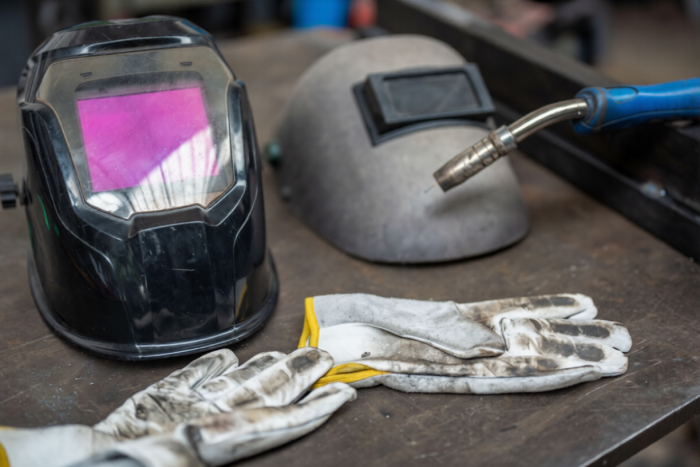
The welding helmet protects the head, face and eyes from UV and infrared radiation, sparks, spatter and flying debris. Modern welding helmets use auto-darkening filters (ADFs) that switch from a clear state to a dark shade the moment the arc strikes, so the welder can see clearly for setup and get instant eye protection when welding starts. Look for shade range (typically DIN 9-13 for arc welding), viewing area size, sensor count (4 sensors is standard, useful for out-of-position work), and grind mode. Passive helmets with fixed shades are cheaper but less practical for varied work.
UK standards: BS EN 175 covers welding helmets and face protection, and BS EN 379 covers auto-darkening filter performance.
2. Safety Glasses and Goggles

Safety glasses and goggles protect the eyes during grinding, cutting, prep and general workshop work, and are worn under the welding helmet during welding itself. They shield against flying particles, dust and impact. Safety glasses are not a substitute for a welding helmet during arc welding, since they offer no protection against UV or infrared radiation.
UK standard: BS EN 166 covers personal eye protection.
3. Welding Gloves
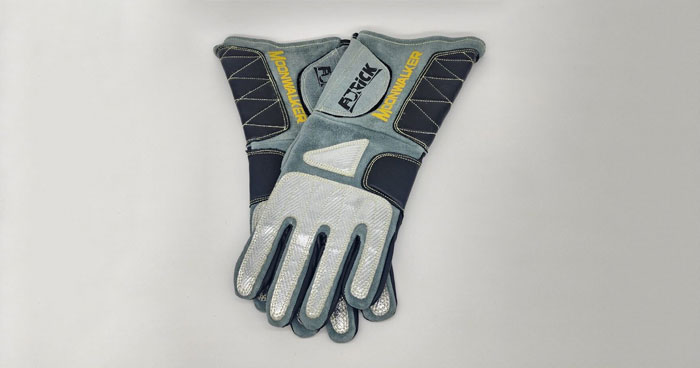
Welding gloves protect the hands, wrists and lower forearms from heat, sparks, spatter and cuts. Material choice affects the balance between protection and dexterity. Cowhide offers heavy protection and is standard for MMA and MIG. Goatskin is thinner and more flexible, giving the dexterity needed for TIG work. Cuff length matters too: longer cuffs protect the wrist and forearm from falling spatter, particularly important for overhead and vertical work.
UK standard: BS EN 12477 covers protective gloves for welders, split into Type A (higher protection) and Type B (higher dexterity).
4. Welding Jackets and Flame-Resistant Clothing
Welding jackets and flame-resistant clothing protect the torso and arms from radiant heat, sparks and spatter. Options range from full leather jackets for heavy work and overhead welding, through to flame-resistant cotton or treated fabrics for lighter workshop tasks. Cover aprons add torso protection for shorter jobs where a full jacket is overkill. Coverage matters: exposed skin at the neck, wrists or waist is where burns happen.
UK standard: BS EN ISO 11611 covers protective clothing for welders, with classes and levels based on the type and intensity of welding work. Browse the full range of welding protective clothing.
5. Welding Boots
Welding boots protect the feet from falling objects, molten metal and hot surfaces. Look for a closed lace design (open laces catch spatter), ankle support and the right combination of safety ratings. Metatarsal guards add cover to the top of the foot for heavier work where dropped material is a risk.
UK standard: BS EN ISO 20345 covers safety footwear. For welding, look for an S3 HRO HI rating: S3 covers the base requirements (steel toecap, penetration resistance, water resistance), HRO adds a heat-resistant outsole rated for hot surfaces, and HI adds a heat-insulating midsole. Metatarsal (M) protection is worth considering for heavier work.
6. Welding Screens and Curtains
Welding screens and curtains protect bystanders and other workshop workers from arc flash, UV exposure and flying spatter. Semi-transparent welding curtains filter harmful UV and infrared while allowing visibility across the workshop, which suits busy shops where movement continues around active welding. Solid screens offer a full visual barrier for higher-intensity work. Colour affects filter level: green, orange and red are the common options.
UK standard: BS EN ISO 25980 covers transparent welding curtains.
7. Respiratory Protection (RPE)
Respiratory protective equipment protects the lungs from welding fume, which HSE now classifies as a Group 1 carcinogen. RPE is required when local exhaust ventilation cannot adequately control fume exposure below workplace exposure limits.
The two main options are:
- FFP3 disposable masks for short duration or lower-fume tasks. Cheap, single-use, and require face fit testing to work properly.
- Powered Air Purifying Respirators (PAPRs) for longer duration or higher-fume work. A PAPR draws air through a filter and supplies clean air to a hood or mask. Powered respirators have an assigned protection factor (APF) of at least 20, significantly higher than an FFP3.
UK standards: BS EN 149 covers filtering half masks (FFPs), and BS EN 12941 / BS EN 12942 cover powered and assisted respirators. Face fit testing is required on all tight-fitting RPE.
UK Standards for Welding PPE at a Glance
| PPE Type | UK Standard | Covers |
| Welding helmets | BS EN 175 | Eye and face protection during welding |
| Auto-darkening filters | BS EN 379 | ADF performance and switching |
| Safety glasses | BS EN 166 | Personal eye protection |
| Welding gloves | BS EN 12477 | Protective gloves for welders |
| Welding clothing | BS EN ISO 11611 | Protective clothing for welders |
| Welding boots | BS EN ISO 20345 | Safety footwear |
| Welding screens | BS EN ISO 25980 | Transparent welding curtains |
| FFP masks | BS EN 149 | Filtering half masks |
| Powered respirators | BS EN 12941 / 12942 | Powered and assisted respirators |
Employers should also consult HSE guidance, particularly HSG139 (welding safety) and WL3 (welding fume), alongside the PPE at Work Regulations 2022 for the legal framework.
How to Choose the Right Welding PPE
PPE choice is process-specific and risk-assessed. The same welder will need different setups depending on the job in front of them.
- MIG produces significant spatter and fume, so heavier gloves, a full jacket and RPE are usually required.
- TIG is cleaner and lower spatter, so thinner goatskin or deerskin gloves for dexterity, but full helmet and eye protection is still required.
- MMA / stick produces heavy spatter and dense smoke, so full leather clothing and RPE across most jobs.
- Plasma cutting requires a high-shade helmet lens, full body coverage and often hearing protection due to noise levels.
Assess the risks first, then match the PPE to the process and the environment.
Final Thoughts
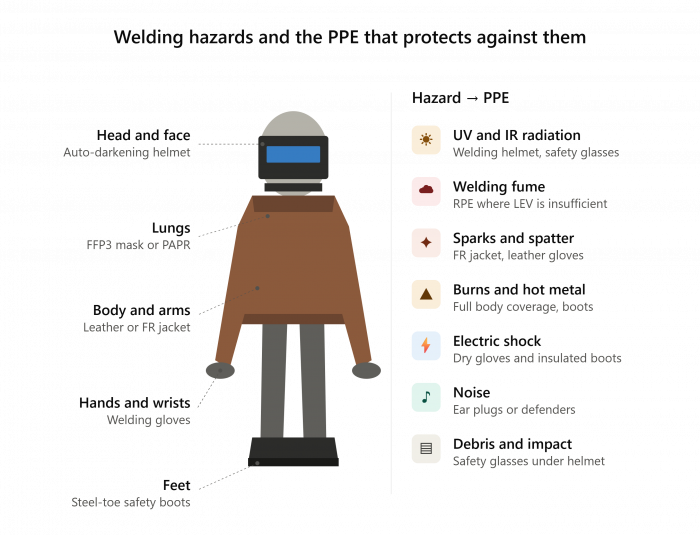
Welding PPE is not optional and it isn’t one-size-fits-all. The right setup matches the process, the material, the environment and the risk assessment, and it stays fit for purpose through regular inspection and replacement. If you’re setting up a new PPE spec for your workshop or looking to bring an existing setup in line with current HSE guidance, the team at TEC Products is on hand on 01845 202989. Browse the full range in our welding protection, clothing, boots and eyewear category.
Frequently Asked Questions
What PPE do you need for welding?
A full welding PPE setup covers seven main areas: a welding helmet with an auto-darkening filter, safety glasses or goggles for prep work, welding gloves matched to the process, flame-resistant protective clothing or a leather jacket, safety boots with steel toecaps, welding screens or curtains to protect bystanders, and respiratory protection where local exhaust ventilation cannot control fume exposure. The specific setup depends on the process, environment and risk assessment, but no welding job should be carried out without at minimum a compliant helmet, gloves, protective clothing and footwear.
What PPE is legally required for welding in the UK?
UK employers have a legal duty under the PPE at Work Regulations 2022 to provide suitable personal protective equipment to anyone carrying out welding, based on a proper risk assessment. In practice, that means at minimum a welding helmet, eye protection, gloves, protective clothing, safety footwear and respiratory protection wherever local exhaust ventilation cannot adequately control fume exposure. Specific requirements vary by process and environment.
Is a welding helmet enough PPE on its own?
No. A welding helmet is one part of a full PPE setup. Gloves protect the hands, protective clothing shields the torso and arms, boots protect the feet, and respiratory protection guards the lungs. Wearing only a helmet leaves the welder exposed to burns, cuts, fume inhalation and foot injuries. A proper setup addresses every route the hazards can reach the body.
How often should welding PPE be replaced?
Inspect PPE before every use. Replace items when they show damage, wear, or when protective performance is compromised. Helmet lenses can degrade after repeated arc exposure. Gloves lose flexibility and develop holes with heavy use. Flame-resistant clothing loses its protective properties over time and with laundering. There is no single replacement schedule; condition and manufacturer guidance determine when to swap out an item.
Comments are closed here.