
Welding Positions Explained: A Guide to Flat, Horizontal, Vertical, Overhead and Pipe
Welding positions describe the orientation of the workpiece and the weld joint during the welding process. They matter because every welding position places different demands on the welder, the equipment and the consumables, and understanding them is essential for producing quality welds. Whether you’re picking up a torch for the first time, working through a certification, or specifying kit for a workshop, this guide details the four basic welding positions, the pipe positions that sit alongside them, the two international standards used to describe them, and how position affects your choice of process and consumables.
What Are Welding Positions?
Welding positions classify a weld based on how the joint is oriented and how the welder has to work relative to it. Gravity pulls the molten weld pool downward in every position, so the position you’re welding in determines the technique, travel speed and often the consumables required to produce a consistent weld.
Two standards classify welding positions. BS EN ISO 6947:2011 is the UK and European standard, using codes like PA, PB, PC and PD. Alongside it, the American Welding Society (AWS) standard uses codes like 1G, 2G, 3G and 4G, and is widely referenced in training materials, spec sheets and certifications internationally. Both describe the same physical positions with different notation.
The Main Welding Positions
There are four basic welding positions covering plate and flat sheet work, with pipe positions treated as a specialist category alongside them. Below, we cover what defines each one, how gravity affects the weld pool, and where each position is typically used.
1. Flat Position (PA / 1G)
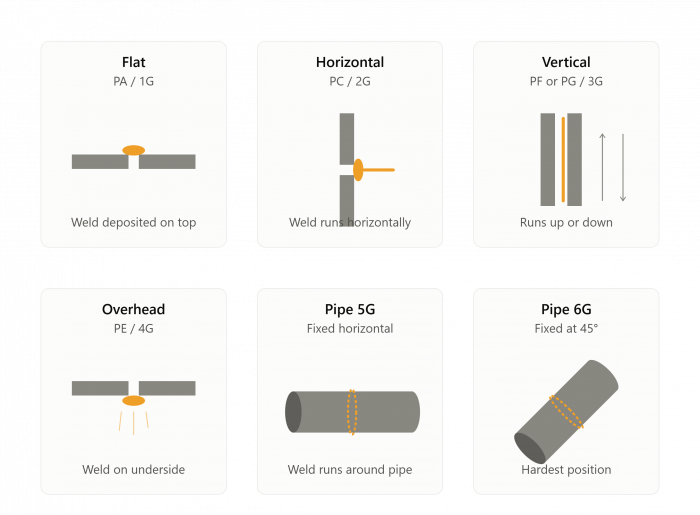
The flat position is the easiest and most common welding position. The workpiece sits horizontally, and the weld is deposited on the upper side of the joint. Gravity works with the weld pool rather than against it, keeping the molten metal in place and allowing higher travel speeds without loss of quality. Any welding process handles the flat position well, and the best weld quality is generally achievable here. It’s the position beginners start with, and the one production shops arrange work into wherever possible.
2. Horizontal Position (PC / 2G)
In the horizontal position, the workpiece is vertical and the weld runs horizontally across it. Gravity begins to pull the molten pool downward, and the welder needs careful control of the electrode angle and travel speed to stop the weld metal sagging out of the joint. Horizontal welding is common in structural steel, tank fabrication and pipe work, and while it’s harder than flat, most trained welders handle it comfortably.
3. Vertical Position (PF or PG / 3G)
The vertical position covers welds where the joint runs up and down the workpiece. It splits into two directions: vertical up (PF) where the welder works from bottom to top, and vertical down (PG) where the weld runs top to bottom. Vertical up gives deeper penetration and stronger welds but is slower. Vertical down is faster and produces a tidier bead but with shallower penetration, so it’s usually reserved for thinner material. Both directions demand technique adjustments to stop the weld pool falling away from the joint.
4. Overhead Position (PE / 4G)
Overhead welding is the most challenging of the four basic welding positions. The workpiece sits above the welder, and the weld is deposited on the underside of the joint. Gravity fights the weld pool the whole way, sparks and molten metal fall directly onto the welder, and the physical effort of holding position is tiring. Overhead work demands heavier PPE, including a leather jacket, thicker gloves and full coverage from our range of welding protection and clothing, since sparks and molten metal fall onto anything exposed.
5. Pipe Positions (5G and 6G)
Pipe welding gets its own set of positions because the joint continuously changes orientation as the welder moves around the circumference. The two key pipe positions are:
- 5G: pipe fixed horizontally, welder works around it, so the weld passes through flat, vertical and overhead positions in a single pass.
- 6G: pipe fixed at a 45-degree angle. This is widely regarded as the most challenging welding position in the industry and is the standard test for high-skill pipe welder certification.
Both positions demand strong hand control, coordination and the ability to adjust technique on the fly as the weld axis changes.
AWS vs BS EN ISO Notation
Both standards describe the same physical positions, so knowing the equivalents is useful whether you’re reading a UK spec sheet or an American training manual.
| Position | ISO Code | AWS Code |
| Flat | PA | 1G |
| Horizontal | PC | 2G |
| Vertical up | PF | 3G |
| Vertical down | PG | 3G |
| Overhead | PE | 4G |
| Pipe (fixed horizontal) | PF (pipe) | 5G |
| Pipe (fixed 45°) | H-L045 | 6G |
The letter G refers to a groove weld. Fillet welds use F codes in the AWS system (1F, 2F, 3F, 4F) covering the same physical positions.
Which Welding Process Suits Which Position?
Not every welding process is equally suited to every position. Here’s how the main processes stack up:
- MIG (GMAW) is versatile across positions, and pulse MIG is particularly useful for vertical and overhead work because it controls heat input and reduces the risk of the weld pool falling out of the joint.
- TIG (GTAW) offers the highest control and cleanest finish, but it’s slower in awkward positions and typically favoured for flat and horizontal work where finish matters most.
- MMA / Stick (SMAW) is often the go-to for pipe, overhead and site work because it handles positional welding well and doesn’t need shielding gas.
- Flux-cored (FCAW) is designed for positional welding on thicker material and outdoor conditions, offering good penetration in vertical and overhead work.
How Position Affects Consumable Choice
Position affects consumable choice as much as it affects process choice. Stick electrodes carry a position code in their designation. For example, in an AWS designation like E6013, the fourth digit tells you which positions the rod is rated for. Common all-positional rods like E6013 and E7018 are specifically designed to work in flat, horizontal, vertical and overhead. Larger diameter electrodes are usually restricted to flat and horizontal work regardless of type. For all-positional options, browse our range of MMA welding electrodes.
The same principle applies to MIG wire and TIG filler wire: match the consumable to the position and the material, not just the material alone.
Equipment That Helps with Difficult Positions
The best way to handle a difficult welding position is often to remove the difficulty. A welding positioner rotates the workpiece to bring the joint into the flat or near-flat position, saving considerable time and improving weld consistency. For repetitive fabrication, pipe work or heavy components, a positioner pays for itself quickly through faster cycle times and better weld quality.
Turntables, pipe rollers, welding tables and clamping systems all help reduce out-of-position welding, and are worth considering wherever the workflow allows it.
Final Thoughts
Understanding welding positions is one of the foundations of any welder’s skill set. It affects the process you choose, the consumables that will work, the PPE you need, and the equipment worth investing in. If you’re planning your setup and want a steer on the right process, machine or positioner for the work you’re doing, the team at TEC Products is on hand on 01845 202989.
Frequently Asked Questions
What are the four basic welding positions?
The four basic welding positions are flat (1G / PA), horizontal (2G / PC), vertical (3G / PF or PG) and overhead (4G / PE). Pipe positions such as 5G and 6G sit alongside these as specialist categories because the pipe joint changes orientation as the welder works around it.
What do 1G, 2G, 3G and 4G mean?
These are AWS position codes for groove welds, widely used internationally alongside the UK’s BS EN ISO 6947:2011 standard. 1G (PA) is flat, 2G (PC) is horizontal, 3G (PF or PG) is vertical, and 4G (PE) is overhead. The letter G stands for groove weld. Fillet welds use the same numbering with an F (1F, 2F, 3F, 4F).
What is the hardest welding position?
The 6G position is widely regarded as the hardest welding position. The pipe is fixed at a 45-degree angle, and the welder has to work around it, adjusting technique continuously as the weld passes through flat, vertical and overhead orientations. It’s the standard test for pipe welder certification for that reason.
Which common welding position is best for beginners?
The flat position (1G / PA) is the best starting point. Gravity works with the weld pool rather than against it, technique is less critical, and it’s the easiest position to produce a clean, consistent weld. Most welders learn the fundamentals here before progressing to horizontal, vertical and overhead.
Do I need a welding positioner?
A welding positioner makes sense when you’re welding repetitively, handling awkward joints, or working with heavy components. By rotating the workpiece into the flat position, it reduces out-of-position welding, improves consistency, and saves significant time. For one-off jobs it’s usually overkill, but for production or pipe work it often pays for itself quickly.
Comments are closed here.